
Can Teacher Preparation and K–12 Speak the Same Language About Practice?

A teacher candidate completes a successful clinical observation. The university supervisor provides feedback on instructional planning, student engagement, and assessment. The cooperating teacher offers suggestions to strengthen classroom instruction, and the candidate leaves with a clearer sense of what to work on next.
A few months later, that same candidate becomes a first-year teacher. The school district uses a different evaluation framework, different indicators, and perhaps an entirely different scoring system. Many of the expectations are familiar, but the language used to describe them has changed.
The teacher hasn't entered a different profession. So why can the conversation about effective teaching feel so different?

Different Systems, Shared Expectations
Educator preparation programs (EPPs) and K–12 school districts have distinct responsibilities. EPPs must demonstrate that candidates are developing the knowledge, skills, and dispositions needed to enter the profession. School districts evaluate practicing teachers while supporting their continued professional growth.
Naturally, their observation and evaluation systems may differ. EPPs may organize their assessments around InTASC standards, state requirements, and program-specific expectations. Districts may use Danielson, Marzano, or other state and locally adopted frameworks.
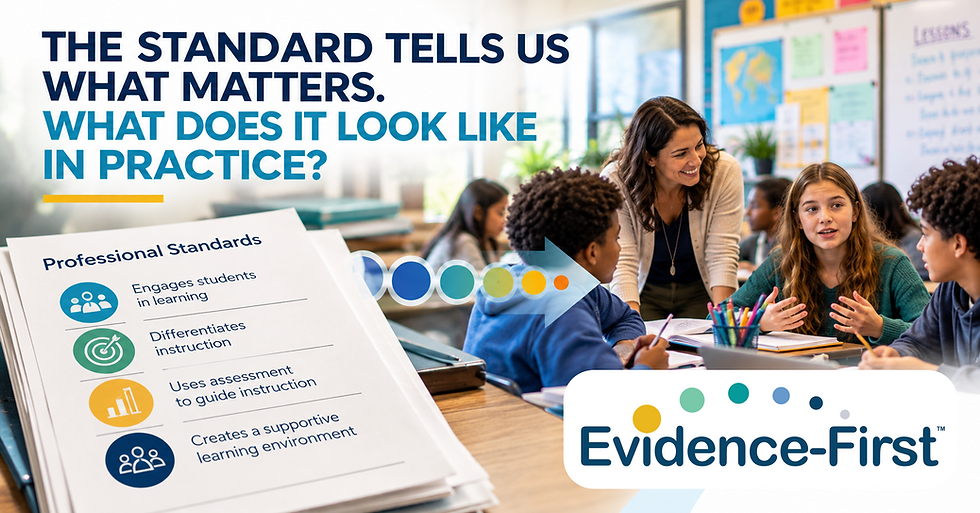
Yet much of what these systems seek to recognize is similar: effective instruction, meaningful student engagement, differentiation, assessment practices, and supportive learning environments.
The challenge isn't necessarily that EPPs and districts use different rubrics. It's whether they share an understanding of what those professional practices actually look like in classrooms.
When Feedback Gets Lost in Translation
Consider a teacher candidate leading a small-group discussion. The university supervisor notices that students are explaining their thinking and responding to one another. The cooperating teacher focuses on how the candidate adjusts questions to help students develop their ideas.
Later, as a first-year teacher, the same educator receives feedback from an administrator who emphasizes questioning strategies and cognitive engagement.
All three observers may be recognizing important aspects of effective instruction. But are they connecting those observations to a shared understanding of professional practice?
Research on school–university partnerships has identified the importance of stronger connections between teacher preparation coursework and clinical experiences. Burroughs et al. (2020) describe how weaknesses in those connections can create barriers to meaningful clinical learning and how collaborative partnerships can help address them.
This concern also appears in accreditation expectations. CAEP's Standard 2 emphasizes shared responsibility between EPPs and their P–12 partners for clinical preparation, candidate development, and continuous improvement (Council for the Accreditation of Educator Preparation [CAEP], 2022).
But a strong partnership requires more than placing candidates in classrooms and coordinating observation schedules. It also requires meaningful conversations about the teaching practices candidates are expected to demonstrate.
When university supervisors, cooperating teachers, and district administrators interpret those practices differently, candidates may receive feedback that feels disconnected, even when everyone is working toward the same goal.
A Shared Understanding Without a Shared Rubric
What if EPPs and K–12 districts focused less on making their evaluation instruments identical and more on establishing a common understanding of observable classroom practice?
For example, a university supervisor and a district administrator might use different indicators to evaluate student engagement. But both should be able to recognize evidence of students explaining their reasoning, responding to questions, or making meaningful decisions about their learning.
That shared understanding creates opportunities for more consistent feedback, stronger clinical partnerships, and a clearer connection between teacher preparation and professional practice.
It's also an important part of the thinking behind Evidence-First™. Rather than requiring EPPs and districts to adopt the same evaluation framework, Evidence-First strengthens the connection between professional expectations and observable classroom evidence. Its methodology provides a way to recognize evidence, connect it to professional practice, and support thoughtful conversations about teacher growth.
For EPPs, this creates an opportunity to examine how well clinical observation practices connect to the expectations candidates will encounter as practicing teachers. For districts, it raises an equally important question: how are those expectations communicated to educators entering the profession?
Teacher preparation and K–12 don't need identical evaluation systems. They need a shared understanding of what effective teaching looks like in practice.
References
Burroughs, G., Lewis, A., Battey, D., Curran, M., Hyland, N. E., & Ryan, S. (2020). From mediated fieldwork to co-constructed partnerships: A framework for guiding and reflecting on P–12 school–university partnerships. Journal of Teacher Education, 71(1), 122–134. https://doi.org/10.1177/0022487119858992
Council for the Accreditation of Educator Preparation. (2022). 2022 CAEP standards. https://caepnet.org/caep-standards/


Comments