
From Professional Standards to Observable Practice: The Missing Step in Evaluation

Professional standards give educators a shared language for effective teaching. They describe important practices such as engaging students in learning, responding to individual needs, using assessment to inform instruction, and creating environments that support student success.
Those expectations matter. But during an observation, an evaluator has to do something the standard itself may not fully explain:
Recognize what that professional practice actually looks and sounds like in a classroom.
That step from the language of a professional standard to observable classroom practice can be easy to overlook. It may also be one of the most important parts of an effective observation system.
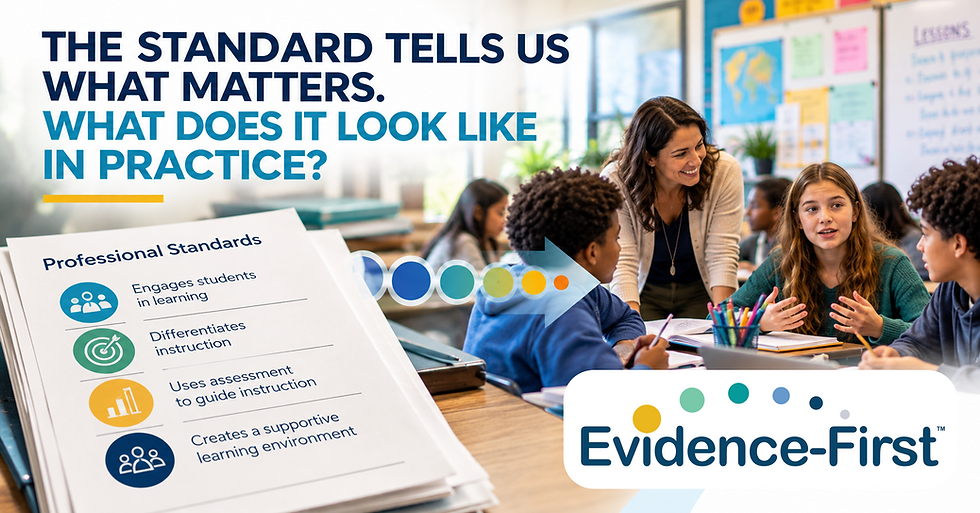
Standards Tell Us What Matters
Professional teaching standards are intentionally broad. The InTASC Model Core Teaching Standards, for example, describe areas of practice that apply across grade levels, content areas, and learning environments (e.g., the teacher shows a deep understanding of the core concepts, tools of inquiry, and structures of the specific academic discipline they teach). Frameworks such as Danielson's Framework for Teaching similarly organize complex teaching practice into domains and components that can guide professional learning and evaluation.
They aren't meant to prescribe a single way to teach.
That's important. Effective teaching should look different in a kindergarten classroom than it does in an AP chemistry lab. A discussion in an English classroom won't look like collaborative problem-solving in mathematics. Supporting individual learners may require very different instructional decisions depending on the students in front of the teacher. The challenge comes when those broad expectations have to be recognized during an actual lesson.
Consider a professional expectation such as engaging students in learning. What would an observer need to see or hear to determine that meaningful engagement is occurring?
Students raising their hands? Working in groups? Asking questions? Explaining their thinking? Making choices? Connecting ideas?
Any of those things might provide useful evidence. But none, by itself, automatically defines the targeted professional practice.
The Missing Step Happens in the Classroom
Observation frameworks help organize professional expectations, but observers still have to connect what unfolds in a classroom to the language of those frameworks. Research on observation systems has shown that the instruments observers use can shape what they attend to and how they understand classroom practice (Klette & Blikstad-Balas, 2018).
That means an important step lies between the standard on the page and the professional judgment that follows an observation: identifying the observable evidence of the practice.
Without a clear bridge between the two, observers may make that translation on their own. One observer may associate engagement primarily with participation. Another may focus on the task's cognitive demand. Another may focus on student choice or collaboration.
The issue isn't that one observer cares about the “right” thing, and another doesn't. The issue is whether the observation system provides enough clarity about the evidence that connects classroom practice to the professional expectation being evaluated.
Build the Connection Before the Score
When evaluation systems aren't producing the consistency or usefulness organizations expect, the instinct can be to revise the standards, rewrite the rubric, or provide additional calibration. But there may be another place to look: Have we clearly connected our professional expectations to the observable evidence of those expectations in practice?
That is the space Evidence-First™ was designed to strengthen. Evidence-First doesn't ask organizations to abandon the professional standards or evaluation frameworks they already use. Instead, it helps make the connection between those expectations and observable classroom evidence more explicit.
That distinction matters because the goal isn't to reduce complex teaching to a checklist of behaviors. Evidence-Firsts gives observers a stronger foundation for recognizing meaningful evidence, connecting that evidence to professional practice, and making the thoughtful judgments evaluation requires. Professional standards tell us what matters; observable evidence helps us recognize it when it happens.
References
Council of Chief State School Officers. (2013). InTASC model core teaching standards and learning progressions for teachers 1.0: A resource for ongoing teacher development. Author.
Danielson, C. (2013). The framework for teaching evaluation instrument. The Danielson Group.
Klette, K., & Blikstad-Balas, M. (2018). Observation manuals as lenses to classroom teaching: Pitfalls and possibilities. European Educational Research Journal, 17(1), 129–146. https://doi.org/10.1177/1474904117703228


Comments